
— About
What is Fab City?
And what does it mean in Cape Town?
Fab City is a global initiative to radically transform cities — from places that consume, to places that produce. The goal: by 2054, cities should produce most of what they consume, and consume most of what they produce locally.
— The Principle
From Products In, Trash Out — to Data In, Data Out.
Today, most cities operate on a PITO model — Products In, Trash Out. Raw materials are extracted elsewhere, manufactured elsewhere, shipped in, consumed, and discarded. Cities are net consumers.
The Fab City model flips this. DIDO — Data In, Data Out — means cities share knowledge, designs, and open-source solutions globally, while producing goods locally from local materials and local energy.
The result is a city that is more resilient, more equitable, and more ecologically responsible — not by consuming less, but by producing more of what it needs, where it needs it.
— Cape Town
Why Cape Town?
Cape Town sits at a particular intersection: a city of extraordinary creative and technical capacity, deep inequality, and urgent ecological pressure. The Fab City model is not an abstract ideal here — it is a practical necessity.
The Western Cape has a long tradition of making, repairing, and improvising. From the informal economy to the design schools, from community workshops to research labs — the raw material for a Fab City already exists.
Our work is to connect these nodes, make the knowledge flow, and build the infrastructure — physical and social — that allows the city to produce more of what it needs.
The raw material for a Fab City already exists here. Our work is to connect it.
— People
The people behind the network
Fab City Cape Town is a distributed effort — researchers, makers, educators, designers and community organisers working across the Western Cape.
Meet the full networkKirstin Wiedow
Fab City Cape Town
Network Lead
Yusuf Vawda
Menzies Design Lab, UCT
Research + Design
Reghard Goussard
ARC of Franschhoek
Living Lab
Safiyya Karim
Fashion Revolution South Africa
Circular Design
+ 5 more contributors
View all →
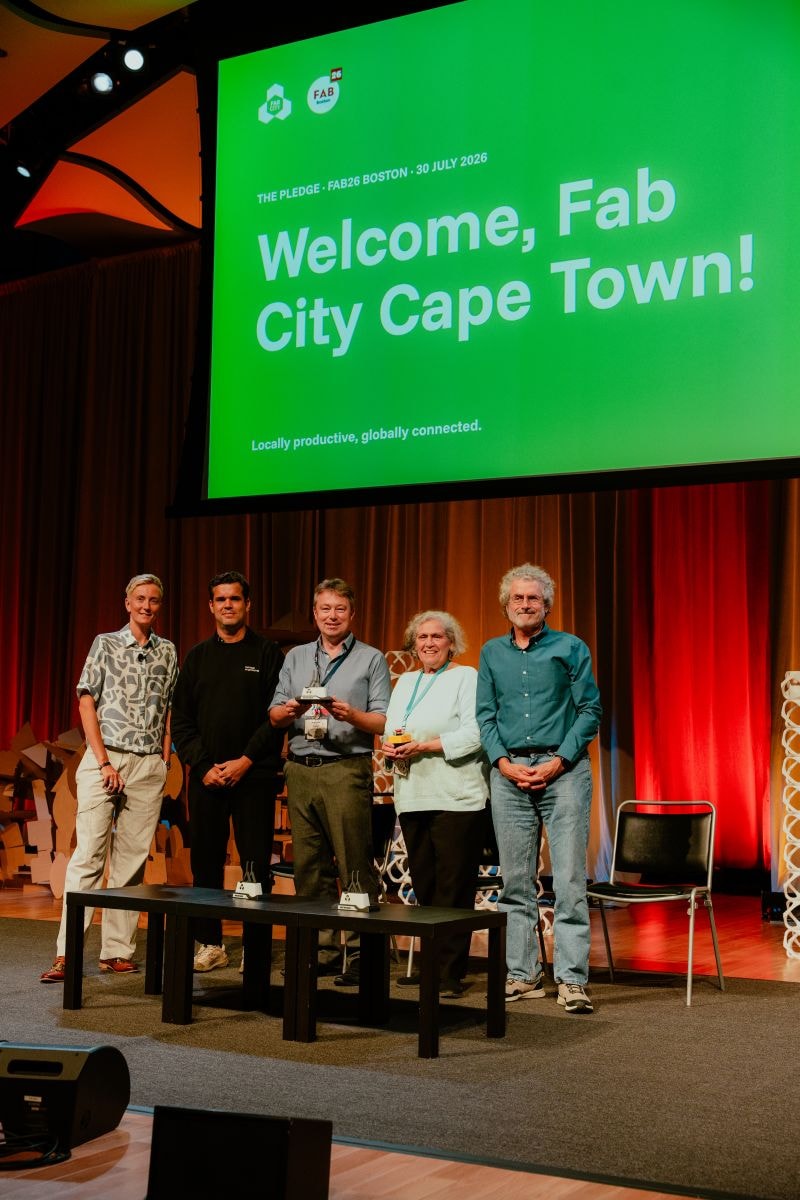
Every year we welcome new cities to the network, but this one carries weight. Cape Town was built as a waystation for the first global supply chain — ships rounding the Cape moved resources from the Global South to the industrialising North. Now, as Cape Town joins Fab City, it has the opportunity to help reverse that logic: building local productive capacity while connecting knowledge globally. This is exactly the kind of transformation the Fab City movement was created to enable.
— Global Network
Part of something larger
The Fab City Foundation coordinates a global network of cities, regions and campuses committed to the 2054 goal. Cape Town is one of more than 50 nodes — sharing knowledge, tools, challenges and solutions with cities from Barcelona to Bhutan.
Visit the Fab City Foundation →Barcelona
Spain
Founding city, 2014
Amsterdam
Netherlands
Circular economy node
Boston
USA
MIT Media Lab partnership
Shenzhen
China
Manufacturing & open hardware
Santiago
Chile
Latin America hub
Cape Town
South Africa
Africa node · est. 2026
Get involved
Whether you're a researcher, maker, educator, community organisation or just curious — there's a place for you in the network.
Join the network →