Fab City Cape Town
Cape Floristic Region
One of the world's six floral kingdoms. Smallest in area. Highest plant diversity per square kilometre on earth. UNESCO World Heritage Site.
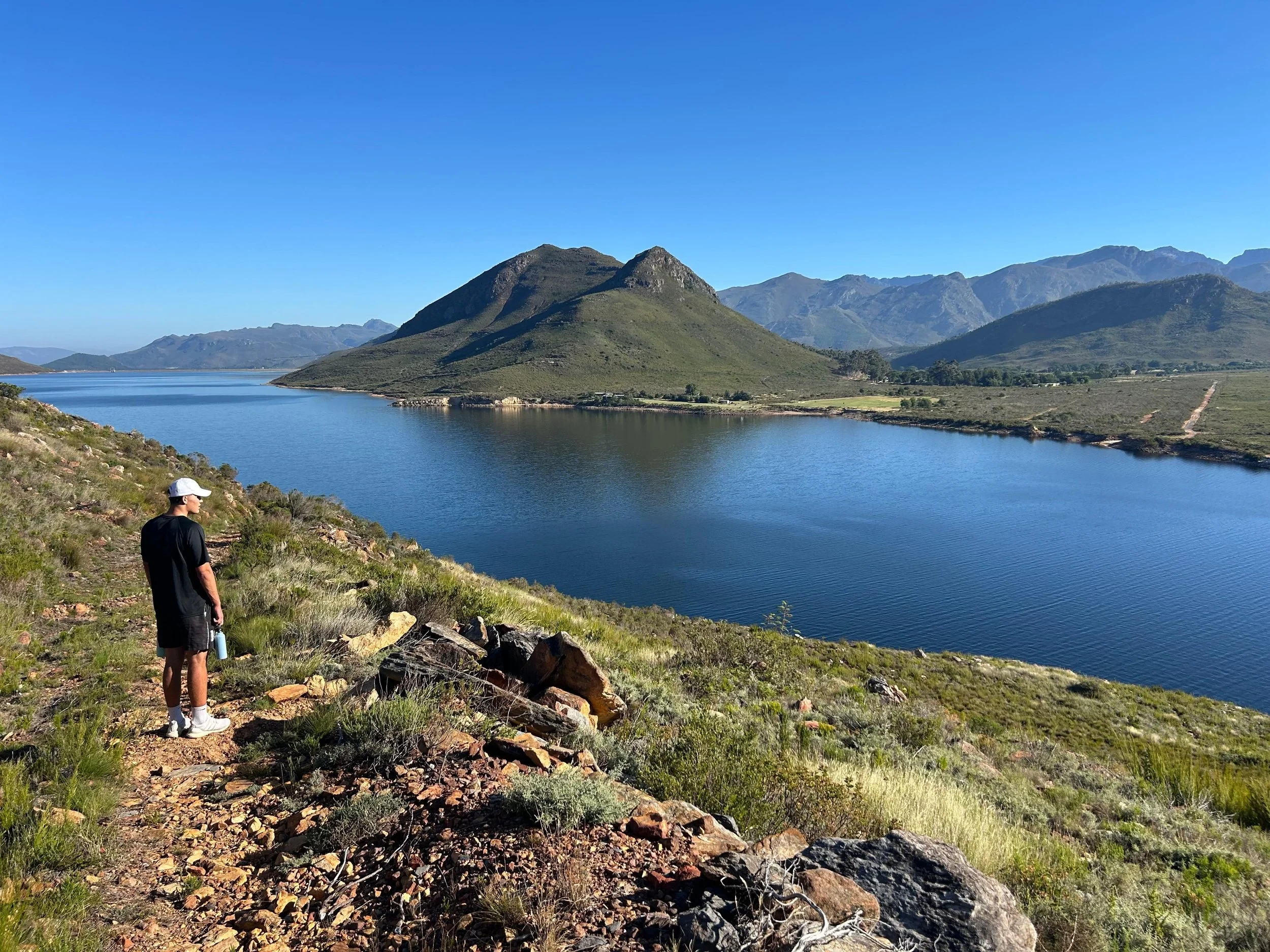
UNESCO World Heritage -- Cape Floristic Region ↗Franschhoek sits in one of the most biodiverse places on earth. The Cape Floristic Region — the smallest of the world's six floral kingdoms — contains more plant species per square kilometre than the Amazon rainforest. Fynbos, the dominant vegetation of the Western Cape, is found nowhere else. It is ancient, extraordinarily diverse, and deeply threatened.
The ARC of Franschhoek is a farm and living laboratory set within this landscape. It is not a museum or a nature reserve. It is an active site of regenerative practice — where questions about land, ecology, food systems and local production are being worked out in real time, through real experiments.
What the ARC is doing
The ARC's work spans several interconnected areas. Regenerative agriculture — building soil health, reducing inputs, working with the landscape rather than against it. Ecological restoration — reintroducing indigenous species, managing invasive plants, understanding how fynbos systems recover. And material research — exploring what the landscape itself produces: fibres, dyes, resins, and other materials that could form the basis of local production.
This last strand is where the ARC connects most directly to Fab City Cape Town's work. The question of local materials — what can be grown, harvested, processed and made here — is central to the Fab City challenge. The ARC is one of the few places in the Western Cape actively exploring this question at a landscape scale.
The ARC is also a site of knowledge production. It works with researchers, designers and students — including through its partnership with Menzies Design Lab UCT — to translate ecological observation into design research, and design research into prototypes. The loop between landscape and laboratory is intentional.

Fynbos as a material system
Fynbos is not conventionally thought of as a material resource. It is celebrated for its biodiversity, its fire ecology, its extraordinary floral diversity. But it is also a system of materials — fibres, tannins, essential oils, natural dyes — that have been used by indigenous communities for thousands of years and are only beginning to be explored by contemporary designers and makers.
Fashion Revolution South Africa, one of Fab City Cape Town's partners, is exploring exactly this territory — working with the ARC to understand what circular textile production could look like when it starts from the landscape rather than from imported materials. What does a school uniform look like when it is made from local fibres, dyed with local plants, repaired locally, and returned to the soil?
These are not rhetorical questions. They are design briefs. And the ARC is the place where they can be tested.
Environmental sensing at the ARC
Fab City Cape Town is developing its first environmental sensing node at the ARC. Using open-source Smart Citizen hardware — the same platform used by our reference node in Singapore — we will begin measuring the landscape: temperature, humidity, particulate matter, soil conditions, and more.
This is not sensing for its own sake. The ARC is a regenerative system in active development. Understanding how the landscape responds to interventions — to restoration planting, to changes in grazing, to seasonal variation — requires data. Open data, shared with the global Smart Citizen network, that can inform both local practice and global research.
When the ARC node comes online, it will be the first open environmental sensing point in the Franschhoek valley. It will connect a landscape of extraordinary ecological significance to a global network of citizen scientists, makers and researchers. That connection is what Fab City is for.
A living laboratory for the network
The ARC is not a partner in the conventional sense — a logo on a page, a name in a list. It is a place where Fab City Cape Town's work becomes real. A landscape question becomes a design brief. A design brief becomes a prototype. A prototype becomes a practice. A practice becomes knowledge that can be shared.
The Fab City network is built on exactly this logic: that local experiments, properly documented and shared, improve the global network. What we learn at the ARC — about fynbos materials, about regenerative practice, about open sensing in a biodiverse landscape — will be legible to Fab Cities in Barcelona, Shenzhen, Detroit and Oulu. And what they know will improve what we do here.
A landscape question becomes a design brief. A design brief becomes a prototype. A prototype becomes a practice. A practice becomes knowledge that can be shared.
Fab City Cape Town, 2026
References & further reading
- ARC of Franschhoek
arcoffranschhoek.com — the living laboratory
- Cape Floristic Region — UNESCO World Heritage
whc.unesco.org — the ecological context
- Fashion Revolution South Africa
fashionrevolution.org — circular textiles partner
- Menzies Design Lab, UCT
uct.ac.za — research and design partner
- Smart Citizen platform
smartcitizen.me — the sensing platform for the ARC node
- Fab City Foundation
fab.city — the global network