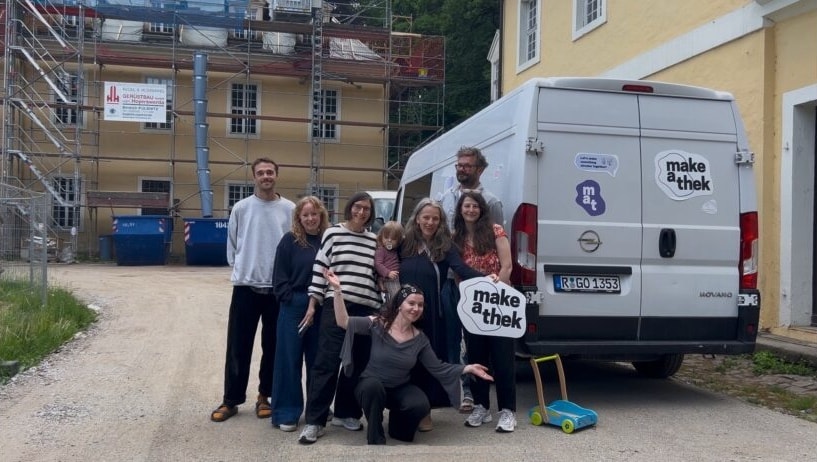
The make-a-thek bus is currently travelling across Europe. It is a converted vehicle carrying tools, materials and facilitators between the project's pilot library makerspaces -- a rolling demonstration of what it looks like when a public library becomes a node for circular making.
make-a-thek is a Horizon Europe-funded project coordinated by the Global Innovation Gathering (GIG), bringing together nine international partners to install creative makerspaces in public libraries. The focus is circular fashion, traditional crafts, and local innovation -- all open-source, all designed to be replicated.
Cape Town is one of the Global South pilot sites. Through the Africa Makerspaces network and GIG's existing relationships with the Western Cape library system, make-a-thek is testing whether the European model -- makerspace tools, repair culture, textile upcycling -- translates into a context shaped by different material realities, different craft traditions, and different relationships to public infrastructure.
Libraries as infrastructure for making
The core argument of make-a-thek is simple: public libraries are already trusted, accessible, and distributed. They are in every neighbourhood. They have staff, opening hours, and a mandate to serve the public. What they have not traditionally had is tools.
The project installs modular makerspace kits -- sewing machines, repair tools, material libraries, digital fabrication equipment -- into selected libraries and trains staff to run making and repair sessions. The open-source framework means any library, anywhere, can adapt and replicate the model.
The bus tour
The make-a-thek bus launched in May/June 2026 and is currently travelling between pilot library sites across Europe. It carries a mobile makerspace -- a demonstration unit that can be set up in a library car park or community space -- and a team of facilitators running workshops on circular fashion, textile repair, and craft.
The tour is documented in real time at makeathek.eu. Each stop produces open-source documentation: what worked, what did not, what the community made, what the library learned. This is the knowledge infrastructure that the Cape Town pilot will draw on.
Live now
The make-a-thek bus is currently on the road across Europe. Follow the journey in real time at makeathek.eu/make-a-thek-bus
Follow the journey at makeathek.eu/make-a-thek-bus
What this means for Cape Town
Fab City Cape Town's involvement in make-a-thek is through the Cape Town make-a-thek Global Pilot -- one of the five experiments listed on the Projects page. The Western Cape has an extraordinary tradition of craft, textile production, and repair culture. The question is whether a library-based makerspace model can connect that tradition to contemporary circular economy practice.
The Africa Makerspaces network -- a Tier 2 partner in the Fab City Cape Town ecosystem -- is coordinating the Global South pilots. GIG, as the project lead, brings the European framework and the open-source toolkit. Cape Town brings the context: the communities, the craft knowledge, the library infrastructure, and the questions that only make sense here.
The bus will not come to Cape Town. But the knowledge it is generating will.